A home is more than bricks and walls; it’s a dream you spend a lot of time turning into reality. The process is filled with emotions, technicalities, and concepts like CC, OC, or PLC. In this post, we will talk about one of these.
Let us start by understanding the full form of PLC in real estate, its importance, impact and role in property values. You must understand this concept, as it presents an additional fee for corner locations and higher floors.
Knowing the facts ensures you calculate property costs, get the ideal deal, and spend the right amount. Here, in this post, let us uncover it.
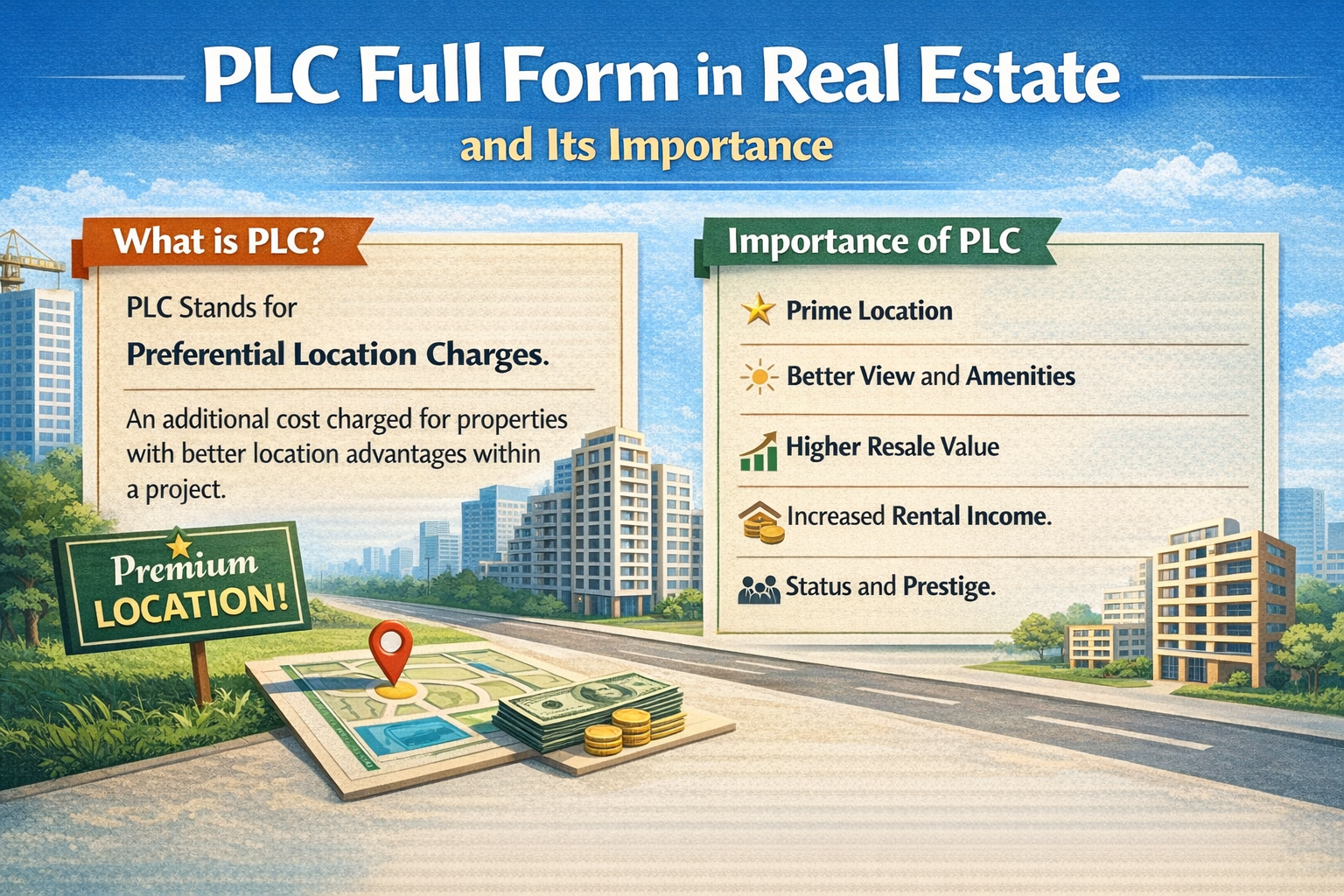
Full Form of PLC in Real Estate
The term PLC can have different meanings. In real estate, PLC refers to the preferred location charges. Developers charge an additional fee for premium housing with more benefits within the project. These can include corner homes or better value. They apply to both residential and commercial properties. For example, a 3BHK with a garden-facing view will hold more value than another flat with a different view.
Why is PLC important?
Now that you know the meaning and full form of PLC in real estate, we can focus on other concepts. In addition to a better view and a peacefully chosen residence, here’s how PLC can add value to your property.
High Asset Appreciation
Preferred Location Charges, or PLC, let you invest in properties with high demand and improved features. This can attract a better resale return and promising rental income. These high-value properties can be sold off more easily.
Improved Return on Rentals
The improved features and premium locations of properties that come with PLC charges make them more attractive for high-end tenants. They are willing to pay a higher rent for these, bringing you a better income. Desirable properties are known for superior views, convenience, and a comfortable lifestyle. The value and desirability of staying for longer can lower the chances of frequent and major renovations.
Better Desirability
Even if you are not purchasing the property as an investment, you can still benefit from its higher desirability. These units have better access to amenities. For example, you get a corner apartment with higher privacy. These can be a sign of an improved living or a high-end status.
Improved Investment Potential
PLC or Preferred Location Charges can secure properties with a higher return value, and you have learned this well by now. However, did you know that a selective choice of property can stand potential market fluctuation? As a result, you enjoy improved long-term goals. PLC charges can be your smart move towards a secure outcome in the future.
What are the different types of PLCs in Real Estate?
In the world of real estate, PLCs can be categorised further based on locations, views, or amenities. Let us discuss the types of PLCs in the section ahead.
View-Based PLC
PLC charges in the real estate sector can differ. Here, we will discuss view-based PLC. These cover locations that face parks, waterbodies, clubhouse/pools, or cityscape views. The purpose of the view-based PLC charges is to provide an improved aesthetic value and tranquillity.
Floor-Based PLC
The floor-based PLC is the additional fee levied for apartments on a specific floor. These units offer improved ventilation, scenic views, and increased privacy. For example, higher floors are more prestigious, offering a sense of exclusivity. In locations like Mumbai, they would be preferred for better ventilation. Ground-Floor PLC can be the choice for families with aged members or those who prefer cooler units.
Amenities Facing PLC
These kinds of PLC charges are associated with better living features. They can cover corner proximity; these can improve the quality of life and deliver a higher retail value. They can be units that are closer to the clubhouse, gymnasium, entrance, or pool.
Corner Unit PLC
The corner unit PLC charges cover apartments located at the edge of a building. These kinds of units come with fewer shared walls, better ventilation, and more privacy. Corner units also have a unique-structure, such as the L-shaped. They can have more spacious floor plans as well.
Vastu-Based PLC
These PLC charges are focused on properties and units around Vastu-Shastra principles. In fact, a notable number of Indian buyers choose homes and units built as per these principles. They are ideal for long-term living of families and can have a better resale value.
Road-Facing PLC
Paying PLC charges for road-facing properties has many benefits. You can choose them for ease of accessibility and greater convenience. Commercial properties, units for rental purposes, can find a road-facing PLC ideal.
What Factors Impact PLC rates in Real Estate?
You thought it was just about learning the PLC full form in real estate? No! In fact, you need to know how it’s calculated and how the PLC charges can differ:
Commonly, the factors that impact PLC rates in real estate are floor level, views and sightlines, or proximity to amenities. In addition to these, luxury projects supported by established developers can demand higher PLC rates. The well-recognised superior developer, offering superior interiors, could be more preferred and have higher rates. Similarly, the city-specific preferences or high-demand areas can influence the apartment costs.
How is PLC Calculated?
Fortunately, by now, you know a lot more than the PLC full form in a real estate setup. We can get straight to the PLC calculation here:
Percentage Method
PLC charges can be evaluated through a percentage method. It can be a percentage of the selling price (base). The premiums can depend on multiple factors discussed previously. This method ensures that the property rate rises as and when property prices do.
Flat-Rate Method
You can use a simple, predictable, and transparent process called the flat-rate method. Under this, the developer uses a fixed amount as PLC charges, regardless of the size and location of the property.
Market Benchmarking
This process includes comparing similar projects for the ideal premium amount for a superior unit. Instead of a fixed price, this method uses a comparative price of the amenities.
Unit Size Differentiation
This method uses an application of a high premium rate for exclusive units. As per this process, the larger units, such as 4BHKs and penthouses, are more luxurious and premium.
Conclusion
Buying that property, which turns out to be your home, is a blend of multiple steps. From learning the PLC full form in the real estate context to understanding how it’s calculated, we have covered it all.
In this post, we learned that PLC charges in real estate can be the difference between an average property and an extensive living experience. You can pick an apartment that is in closer proximity to amenities, is on a specific floor, or offers privacy with its corner location.
The real estate world experiences different types of PLC charges, ranging from a corner to an amenities-based one. They can be calculated through different methods, including unit size differentiation, market benchmarking, or percentage on base value.
Frequently Asked Questions (FAQs)
What is PLC in real estate?
In the world of real estate, PLCs refer to the charges for preferential location. These additional costs are being taken for superior views, amenities, proximities, or better ventilation.
What is the PLC per sqft?
The PLC charges can go from INR 50 to INR 500 for each square foot. These are applied to base costs to obtain the basic desirable features of the unit.
What are the PLC charges in the plot?
In the world of real estate, PLCs are the charges for additional features for units or plots with premium or superior amenities. These are set over the base price to present more desirable features, such as improved views and corner access.
What are PLC and FRC charges?
Both PLC and FRC are additional charges applicable in the real estate context. They’re both paid for a better-positioned unit. FRC refers to an incremental fee meant for higher floors. PLC, on the other hand, is for premium features, such as corner, park-facing, or pool-view flats.
What does PLC stand for in property?
In the context of property, PLC also stands for preferential location charges. These are paid for additional amenities, over the base value of the property.
What is a floor PLC in real estate?
A floor PLC refers to the charges paid for units situated on a specific floor. For example, floors 1-5 may cost the base price. However, for the next few floors above that- such as 6-9, the costs can go INR 50 for each square ft. Similarly, the prices can rise to 100 per square ft.
What is facing PLC in real estate?
Facing the PLC are the additional charges for units with a specific view. This can include parks, sea-facing, or garden-viewing.
How can I calculate floor rise charges in real estate?
The floor rise charges are calculated by multiplying the rate per square foot by the number of floors beyond the base levels, applicable to the total area of the apartment. Have a look here:
FRC = (Number of Chargeable Floors X Floor Rise Rate) X Super-Built-up Area