The real estate industry in India is booming, bringing hundreds of people closer to their dream homes. Many can picture this as the beginning of great investments, security, and comfort, but what about several roadblocks in the way? The technicalities? The legal terms? The formalities?
In the post, we will cover one such concept. We will tell you about IOD full form in real estate context, its role in your homeownership, and everything you need to know.
IOD Full Form in Real Estate: What it Is?
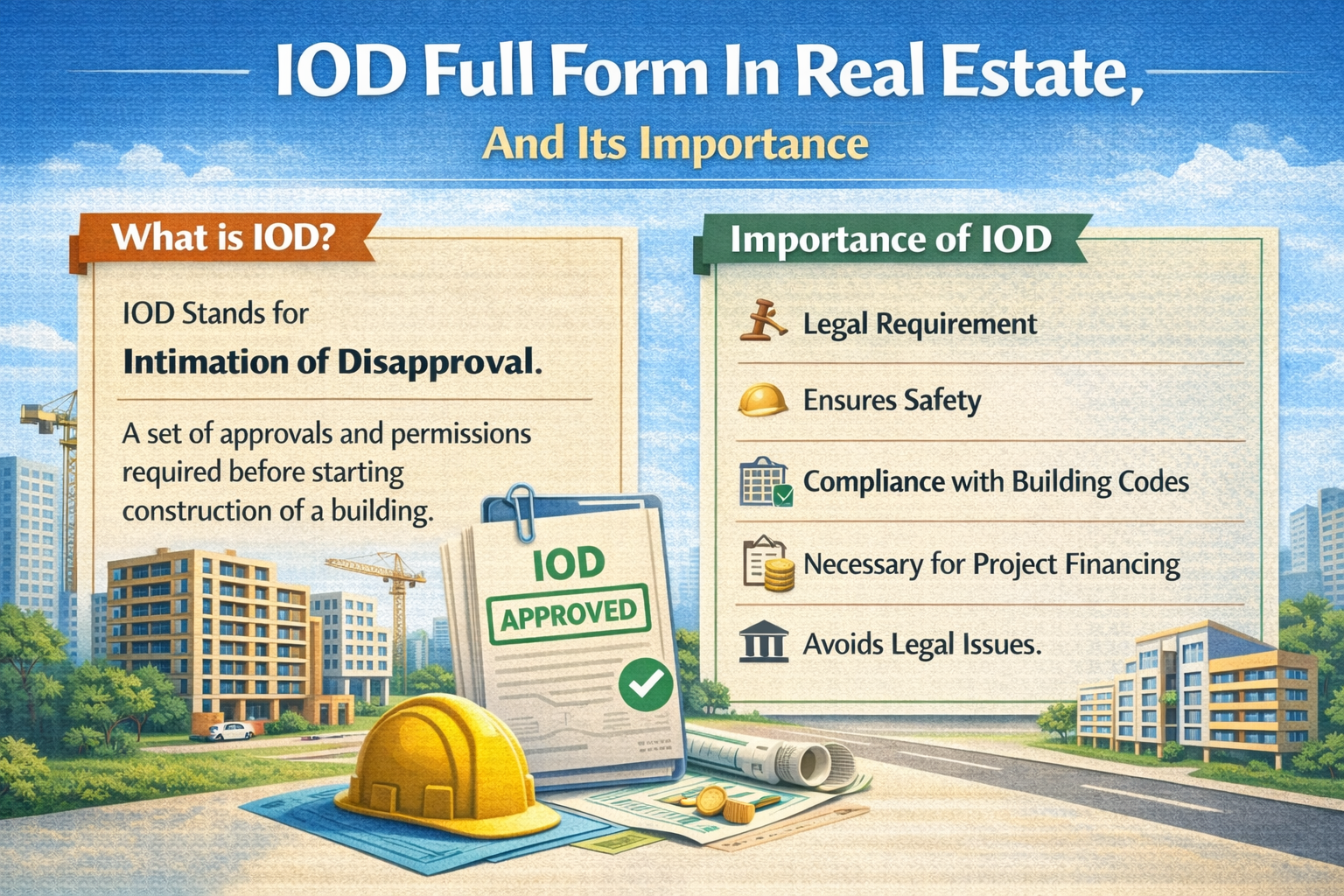
Let us start with the full form of IOD, of course. The term has different meanings, but in real estate, IOD refers to the Intimation of Disapproval. It is a preconstruction approval coming from local authorities. It ensures that a project adheres to safety, zoning, and other legal regulations.
Importance of IOD in the Construction of a Project
An Intimation of Disapproval is more than another document. It is necessary in real estate for several compliance, risk, and legal reasons. Learning about it is important for a developer, investor, and buyer. In this section, let us tell you what the role of IOD is in real estate:
Regulatory Compliance
Talking of regulatory compliance with an IOD in real estate, it’s totally uncompromisable. It ensures all legal requirements are being adhered to, meaning all the construction is legal and approved. This can prevent any delays or penalties. Instead, it can pave the way for the commencement certificate, which is another essential legal document. An IOD also lists down the essential approvals the project needs to obtain. It is nothing less than a green light for the construction to commence.
Legal Compliance
An Intimation of Disapproval is a legal necessity in the world of real estate, particularly before the construction commences. It serves as a pre-commencement mandate, hindering any illegal building. It also defines necessary clearances, such as environmental and fire. Since the project construction with IOD is legally protected, the buyers and investors can be assured of no future conflicts.
Risk Reduction
Risks are everywhere, but not in real estate with IOD. The Intimation of Disapproval acts as a risk barrier for any construction project. It ensures that your construction project works well with structural, zoning, and safety regulations. It serves as a plan of action, which avoids unauthorised construction, project delays, legal actions, and similar kinds of risks.
Redevelopment Necessity
It’s not just in a new project’s construction, but IOD can also work ideally in redevelopment. Over there, it confirms that the project plan works in accordance with building regulations. From securing finances to ensuring timelines or streamlining operations, the Intimation of Disapproval document is necessary for all of these.
Conditional Approval
The ‘Intimation of Disapproval’ acts as a confirmation of a project’s compliance with safety and zoning regulations. That way it details that all the mandates, covering fire, environmental, etc, are being approved. Despite the term’s disapproval, the IOD is a major milestone for a project’s approval.
What is the Eligibility Criteria for the IOD Certificate in Real Estate?
Fortunately, now you know much more than the full form of IOD in the real estate context and can move a step ahead. If you are a developer looking to apply for an IOD certificate in real estate, here is the set of documents required:
- Legal Ownership Details of the Land
- Architectural Records
- No Objection Certificate from Different Authorities
- Site Analysis Reports
- Structural Stability Certificate
- Receipts of Property Tax
- Environmental Impact Assessment
- Developmental Receipts
How Buyers Can Verify IOD Status?
Beginning a construction without an IOD document can make a project unauthorised. As a buyer, the absence of an Intimation of Disapproval document can bring a significant investment loss. The project might face demolition and legal consequences. It forbade the developers from obtaining an Occupancy Certificate or a Commencement Certificate.
Considering that, you must look for the IOD status of the project you plan to invest in. Here’s how you can check if the project you’re investing in has IOD approval:
- Visit the RERA website, search for the project you’re planning to invest in, and check its approved documents or certificates.
- Check with the local authority’s civic body website.
- Ask your developer for their IOD status before agreeing to invest in their property.
- Look for the project approval during the site visit. RERA mandates its projects to present approval on the site, which, if you visit, you can search.
Difference Between IOD, CC, and OC
As of now, we’ve covered many more concepts than the IOD full form in the real estate world.
In the section ahead, let us learn the similar or associated concepts. We’ll begin by understanding the difference between IOD, CC, and OC. All of these are necessary concepts and terminologies in the real estate world. Here’s how they’re different:
Definition
Let’s start by learning the meaning of each of these. An Intimation of Disapproval is the initial document. It lists the conditions a developer needs to fulfil before obtaining the building approval.
A Commencement Certificate, on the other hand, is the document obtained to start the construction of a building. The Occupancy Certificate tells that a building or a project has been built as per the approved plan and can be permitted to be lived in.
Stage and Purpose
In the world of real estate, an IOD is needed before the construction begins. It serves as an outline for the construction. The Commencement Certification is required when the construction starts. It ensures that construction takes place according to the pre-set conditions and terms.
The Occupancy Certificate is needed or obtained after the construction is completed. Obtaining it is necessary to get the utility connections.
| Document | Intimation of Disapproval | Commencement Certificate | Occupancy Certificate |
| When | Before Construction | During beginning of construction | After construction completes |
| Why | Outlines condition for approval | Ensures construction begins as per the plan | Validates the building’s safety for occupancy |
| Who | Local municipal or planning body | Urban development authority or local municipal body | Urban development authority or local municipal body |
Difference Between IOD and IOA in Real Estate?
In addition to the IOD, the construction also mandates many other documents, such as the IOA.
Unlike IOD, the full form of IOA in real estate is Intimation of Approval. However, it is also needed before construction begins. Here’s how they’re both different:
Definition
An IOD is a conditional approval outlining the necessary outlines. On the other side, an IOA states that the building plans adhere to building and zoning rules. It describes the conditions that must be met before construction can begin.
Purpose
The objective of an IOD document is to outline the necessary clearances, such as height, fire, and environment. The IOA document, on the other hand, aims to show that the project complies with regulations and can be moved to the next stage.
Timeline
Both IOA and IOD are meant to be issues before the construction begins. Both of these documents serve as the green light for the development to commence.
Now that you know the full form of IOD in real estate, let us move to the next step. In the coming section, we will discuss the process of obtaining an IOD in real estate.
How to Apply For IOD in Real Estate?
It takes a systematic process to apply and obtain the Intimation of Disapproval. Developers have to pursue necessary approval from the local planning authority, and here is a series of steps regarding that:
- The process begins with the submission of a detailed development or building plan. The developer needs to carry the necessary documents when sharing these with the local planning authority.
- Once you have submitted those, wait for the planning authority to review your plan. They need to ensure that your plan adheres to the necessary compliance.
- You can expect a site visit by the authorities to inspect the project compliance.
- The non-compliance can be a hindrance. However, if your development project meets all the checklist items, you will be granted the Intimation of Disapproval.
- If your plan got disapproved, you can work on the areas of improvement and then submit it.
What Makes You Eligible For IOD in Construction?
As a developer, here is the criteria you must meet to secure your Intimaition of Disapproval document:
- Valid evidence of ownership of the land, such as the title certificate or sale deed
- Detailed structural designs and architectural designs with approval from an architect or engineer
- Compliance with local land use or zoning regulations
- No violations or outstanding dues with the planning authority
- Payment for all development fees
- No objection certificate from the relevant authorities, including fire, sewerage, and environmental
Conclusion
Everyone who is a part of the real estate industry needs to be clear with many concepts, and IOD is one of them. Considering that, we have dedicated this post to understanding the meaning, importance, and full form of IOD in real estate context.
An IOD or Intimation of Disapproval is a necessary document before commencing construction. It serves as a green light stating that the development complies with zoning and building regulations. An understanding of the concept and approval from the regulatory bodies can result in a compliant and successful project.
Frequently Asked Questions
Who Issues the IOD Certificate?
As mentioned previously, IOD in the construction or real estate terms is issued by the local planning authority or municipal body.
What is the difference between IOD and CC?
An IOD or Intimiation of Disapproval is a pre-construction approval, while a CC refers to the Commencement Certificate that certifies that all the conditions met. An IOD serves as an outline of the compliance, and CC validates it.
Who issues IOD in Mumbai?
If you are planning to proceed with a construction or development project in Mumbai, you will have to approach the Brihanmumbai Municipal Corporation or Municipal Corporation of Greater Mumbai.
What is the difference between IOD and IOA in real estate?
An IOD and an IOA are crucial documents in real estate. Though often used interchangeably, these are different. An IOD outlines the mandates needed to commence the construction. However, an IOA indicates the initial approval.
Why is IOD required?
The purpose of an IOD is to ensure the compliance of a building plan with zoning, safety, and structural regulations.
What are OC and CC in RERA?
An OC stands for an Occupancy Certificate, while a CC is a Completion Certificate. Both of them are crucial documents in the real estate domain and are mandated by the RERA. They are issued by the local municipal authorities and tell about the safety and legal compliance of the body.
What are EC and CC in property?
An EC stands for Encumbrance Certificate, while CC is Completion Certificate. An EC validates that the property does not have any monetary or legal liabilities. On the other hand, a CC states that a building was constructed as per the pre-decided plans or approval.
What is the difference between DTCP approval and panchayat approval?
A DTCP approval is needed for large commercial projects, residential layouts, and areas thriving with urban expansion. A panchayat approval, on the other hand, is a mandate for small-scale construction, such as individual homes.