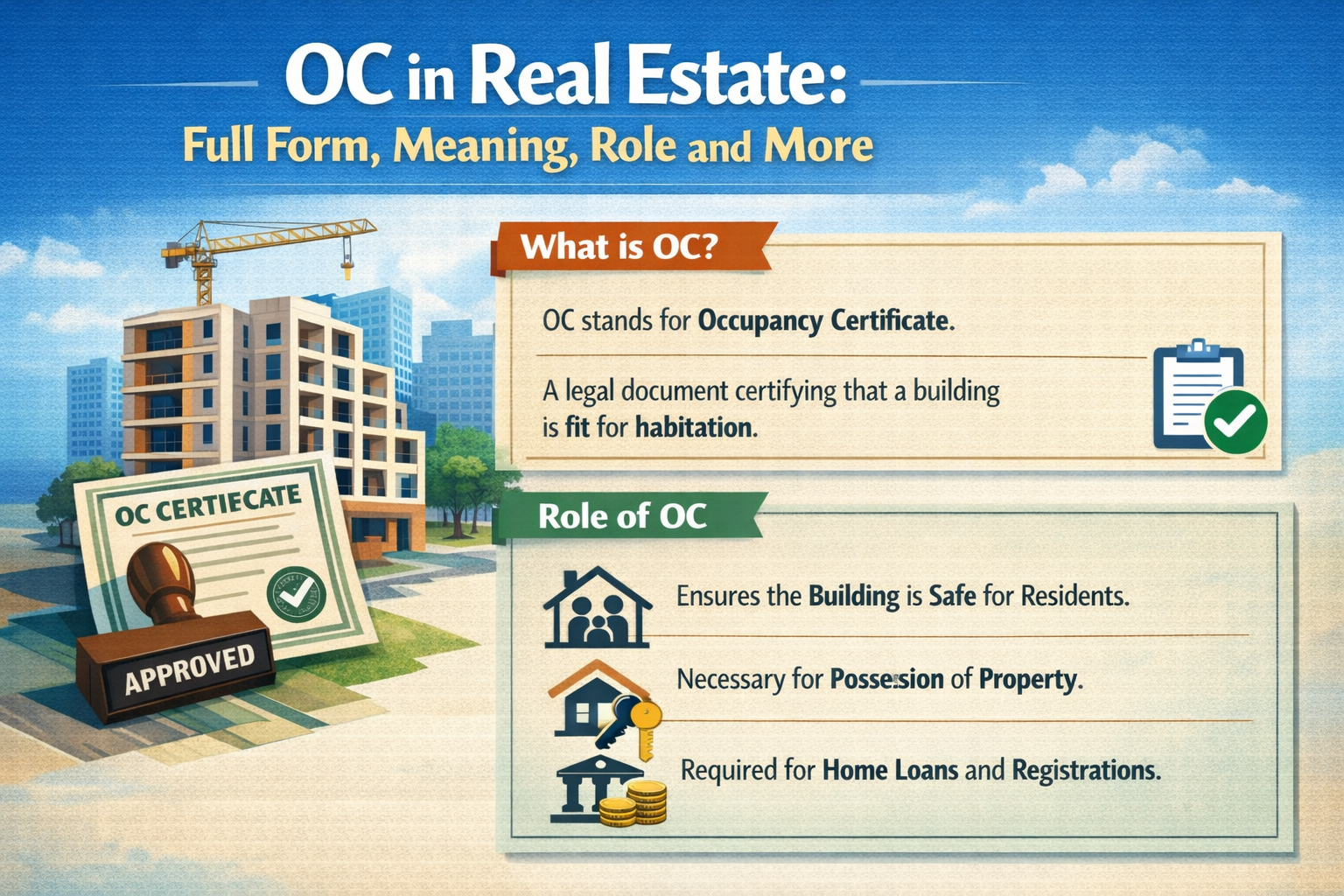
OC is more than a legal document. It verifies that a building has been built and developed in compliance with approved plans. This certificate also verifies the use of building codes and legal norms. A developer needs to present a building as ready for habitation.
An Occupancy Certificate is essential for builders and property owners. Considering that, we are dedicating this post to understanding the OC full form in real estate, its importance, and how to apply for one.
What is the Full Form of OC in Real Estate?
An OC in real estate stands for an Occupancy Certificate. The term is used interchangeably with Certificate of Occupancy or Building Use Certificate. As per RERA, the Real Estate (Regulation and Development) Act, an OC is a legal document issued by local authorities to verify a building’s construction compliance with safety codes, plans, and security requirements.
Why Is OC Important in Real Estate?
Now that you know the full form of OC in real estate, let us move to other related aspects. This certification is important for legal possession, utility connection, and resale purposes. Here’s a deeper picture:
OC, A Certificate as a Legal Requirement
An Occupancy Certificate is a legal requirement for developers to obtain before declaring the building ready for occupancy. It states that the building has been made under safe and compliant benchmarks. An OC also tells about the building’s compliance with structural stability, fire safety, and sanitisation standards.
OC for Financial Aspects
Financial institutions and banks look for an Occupancy Certificate before verifying a property for a home loan. This is because the OC tells about legal and safety compliance. Similarly, an insurance company may not approve any claims in the absence of an OC. Legally, an OC or Occupancy Certificate provides the building with an authorised certification. Anyone who wants to sell a property needs to have an occupancy certificate for it.
Resale Value
An Occupancy Certificate can affect your property’s resale value. Due to its role in validating a building’s compliance, it eases ownership transfer of the property. The buyers can leverage easy approval of bank loans for home purchases. Not to mention, the role of an OC in approving the essentials and utility supplies.
Risks of Buying a Property Without OC
Since you reached here searching for OC full form in real estate, you might also want to consider the absence of having one. Have a look at the key risks and challenges of purchasing a home without an occupancy certificate:
Legal Action
A building is considered unauthorised in the absence of an Occupancy Certificate. As a result, you may face the risks of heavy fines or eviction notices by legal authorities. The possibility of demolition of the property may also exist.
Absence of Essential Utilities
You may not receive a permanent electricity, water, and sewerage connection from the municipality. As a result, you may be left with temporary, unreliable, and unreasonably expensive options.
Unreliable Habitation
There will be legal and financial issues. Additionally, you may face safety concerns with your residency. Afterall, there will be no assurance that your property adheres to fire safety concerns and structural aspects.
Legal Liability and More
Even if you purchase the property, you may still not be a ‘bona fide purchaser’ of the property. Considering that, you won’t have any legal protection if your building faces litigation. It is advisable to look for an occupancy certificate before purchasing a property.
Difference Between OC and CC
In the world of real estate, the OC and CC are two important legal documents. While the OC, whose full form is Occupancy Certificate, has been explained till now, we will dedicate this section to understanding the CC.
Let’s start with the meaning! CC, like OC, is also required for proper ownership and securing the essentials. However, a CC or Completion Certificate validates that the building was built as per the approved plans. The CC is issued once the building has been finished. The OC is issued later and validates the safety for inhabitation.
Is OC Mandatory for All Properties?
OC full form in real estate is more than Occupancy Certificate. It is instead the beginning of safe living. It has to be legally necessary for new residential and commercial buildings, at least for most of them. However, the independent or residential building with a low-structure in certain locations may not need one. Here’s how you can check if your building needs an OC or a Certificate of Occupancy:
- It’s a new residential or commercial building.
- It’s ready-to-move flats/apartments.
- It’s a RERA-approved project.
- It’s a resale property.
How to Check the OC Status of a Property?
As of now, we have already learned the meaning and role of an Occupancy Certificate. Let us dedicate the coming section for buyers to check whether the building or apartment that you are planning to purchase has an OC:
Ask Directly
Start by asking the property developer or seller directly about the Occupancy Certificate. Instead of a receipt for the application, it is better to ask for a copy of the original.
Check RERA Portal
If the project through which you’re purchasing the home is registered under RERA, you can check the RERA website, as builders need to update the status there.
Visit your Authority Online
Visit your city’s online portal and check the OC status through the building plan or building proposal section.
Verify Physically
You can visit the urban development authority or municipality to check the records for a project’s occupancy status.
How to Apply for an Occupancy Certificate?
An Occupancy Certificate is an essential document. You can obtain it through a straightforward process. Here’s how to get a Certificate of Occupancy:
- Property owners and builders can start by ensuring that the building itself is built to meet necessary standards. It’s advisable to ensure this before you apply for the OC or Certificate of Completion.
- Submit your application to the local municipality.
- You will be required to share other necessary documents, such as a Certificate of completion.
- Wait for the authorities to come and conduct the inspection.
Here are the documents needed for the Occupancy Certificate:
- Application form filled with the necessary details
- A completion certificate
- No objection certificate or NOC from the fire department
- Pictures of the building
- A certificate of structural stability
- Copy of sanctioned plan
Conclusion
This is the end of the blog post on the Occupancy Certificate. From the OC full form in real estate world to the necessary steps to obtain one, we have answered all it takes to understand the Occupancy Certificate. However, before calling this post a wrap, let us give you a quick review.
An OC or Occupancy Certificate is a necessary legal document. You can obtain one through the local municipal body. It proves that the building has been built in accordance with safety compliance. A developer or building owner needs to obtain it to get necessary water/electricity connections, legal occupancy, and further sale. Applying for it is easy and requires a completed application, a completion certificate, and other necessary documents.
FAQs About OC in Real Estate
What are OC and CC in property?
OC stands for Occupancy Certificate, and the full form of CC is Completion Certificate. They are both important documents in real estate. A Completion Certificate tells about the finalisation of the building, as per the approved plans. It is issued first, and then the occupancy certificate is assigned. The Occupancy Certificate states that the building has been constructed to meet the safety measures and norms.
What is the process of obtaining an OC?
As a developer or owner of the property, you need to submit a completed application with a Completion Certificate, NOCs, and approved plans. It needs to be submitted within a month or 30 days after the construction is completed.
What is OC proof?
An OC proof or occupancy certificate is a document to be obtained from the local municipal authorities. This legal document confirms that a building has been built as per the necessary safety norms.
What happens when OC is received?
This ensures that a building complies with safety norms. Once you have obtained it, you can start living there, register it, avail necessary utilities, and even sell the property.
Can I sell a flat without OC?
It is illegal and risky to sell a flat without obtaining its Occupancy Certificate, as the building might not be safe to live in.
What are EC and OC?
An EC refers to an Encumbrance Certificate that provides that a building is free from any debt. OC, on the other hand, refers to the Occupancy Certificate, which validates a building’s compliance in terms of safety.
Can a builder give possession without OC?
Not legally.
What are the 7 stages of construction?
The 7 stages of construction begin with concept and initiation. The next steps are design and development, pre-construction/permitting, procurement, construction/execution, closeout, and occupancy.
What are the three documents in possession?
As per the common property transaction checklists, the three necessary documents are a Possession Letter, a Title Deed, and an Occupancy Certificate.
What is the 12-year property rule in India?
The 12-year property rule, as per section 65 of the Limitation Act, states that a person who is in constant and hostile possession of a private property for a period of 12 years can claim ownership legally if the original owner doesn’t take action.
How to download the Occupancy Certificate?
Visit the original website of your municipality body, go to the property services or building permission section, add property or application details, and download.